
From General Relativity to Graviton Pressure Theory
Why General Relativity describes gravity without explaining it, and what a force-based model offers in its place.
Graviton Pressure Theory
Physics can predict where a falling apple lands to many decimal places. It still cannot say what touches the apple. Graviton Pressure Theory proposes an answer: gravity is a push from a medium outside, not a pull from within.
The question physics stopped asking
General Relativity is one of the most precise descriptions ever written. It says objects follow the curvature of spacetime. It does not say what physically pushes or pulls them along that path, or how curvature makes your legs feel your weight.
A description can match every measurement and still leave the cause unnamed. Graviton Pressure Theory starts where the description stops.
“The description is extraordinarily precise. The mechanism is unspecified.”
The test applied to every explanation
What touches what, and what is exchanged?
An explanation that names a physical contact is a mechanism. One that only names the effect is a description. The same test is applied to mainstream physics and to Graviton Pressure Theory itself.
The same principle that lets air pressure hold a suction cup to glass, applied to a medium that fills all of space.
Space is not empty. It is filled with a field of tiny particles, gravitons, streaming in every direction at or near the speed of light. They repel each other, so after they collide with matter they spread out and recover.
Matter absorbs and slows part of the stream passing through it. Near a planet, less of the medium arrives from the planet's side than from open space. That difference is a pressure gradient.
Pushed harder from outside than from below, objects move toward the planet. What we call weight is the ground pushing back against that inflow. Gravity is a push from outside, not a pull from within.
Free to read in full. New to the theory? Follow the Start Here pathway, or see every paper in the library.
Why General Relativity describes gravity without explaining it, and what a force-based model offers in its place.
Two theories giving the same numbers do not agree about what exists. How physics switches between force and geometry without saying so.
A worked test of what each framework says is physically happening when a boulder rests on the ground.
The complete framework: the graviton field as the physical substrate of gravity, with the mathematical formulation and proposed tests.
The medium's properties worked through in detail: self-repulsion, oscillation, inflow toward mass, and the effects they combine to produce.
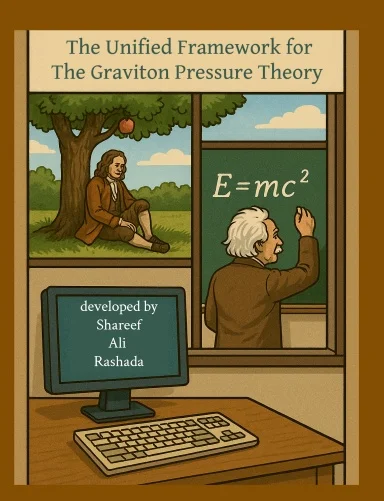
The book
The complete framework in one volume, by Shareef Ali Rashada.
ISBN 978-1-326-48805-5 · Lulu Press
A theory earns trust by showing its open problems. Here is what is finished and what is still being worked out.
Physicists and mathematicians who want to help solve the open problems, or test them, are welcome. Write to shareef@peopleoftheworld.net.
Free to learn · licensed for profit
Students, teachers and curious readers use the papers freely. Courses, publications or products that earn money from the material work with People of the World under a licence.
A four-minute introduction, and Le Sage's push theory of gravity revisited. Every part of the framework has its own Deep Dive episode in the library.
An email when a new paper or result is published. Nothing else unless you ask.