
Library › The Unified Framework for the Graviton Pressure Theory
Units, Constants and Conversions
The Numbers of the Medium
About This Paper
Part 23 set out GPT’s equations.1 This paper gathers its numbers: the units it uses, the constants of the medium with how each is known, the conversions between GPT’s quantities and the quantities instruments read, and a table of worked values from a GPS satellite to the horizon of a black hole, each checked against a measurement. It also restates the first edition’s derived quantities, coherence resistance, the coupling ratio and the graviton torque, in terms of what has since been measured.
This second edition merges the first edition’s Part 24, GPT Unit System and Dimensional Foundations, with the constants and conversions of its Part 25, Constants, Conversions and Deep Field Formalism. The deep field, matter and medium under extreme compression, receives a short section here; a fuller treatment is under consideration. The list at the end says what changed and why. Claims are marked by their status, as the key shows.
One System of Units
The first edition introduced the graviton pressure unit, gp, as momentum delivered per unit area per unit time, and noted that it is dimensionally the pascal. It is the pascal [Argued], and this edition uses SI units throughout. GPT does not need new units. It needs new readings of the quantities that instruments already measure: a pressure in pascals is the medium’s pressure; a frequency in hertz is a structure’s rhythm; a speed of \(c\) is the speed of the medium’s waves.
The SI itself has been rebuilt on rhythm and on the medium’s wave speed. [Argued] Since 2019 every SI unit has been defined by fixing the values of seven constants:2
the second is 9,192,631,770 periods of the radiation from a transition in the caesium atom: a count of a structure’s rhythm, which is what Part 18 says time is;3
the metre is the distance light travels in \(1/299{,}792{,}458\) of a second: a length defined by the speed of the medium’s waves;
the kilogram is defined by fixing Planck’s constant \(h\), so that a mass is measured through the frequency \(f = mc^2/h\). A kilogram corresponds to \(1.36\times10^{50}\) hertz.
In GPT this is not a convenience. Mass is the rate at which a pattern turns over the medium (Part 17), and \(mc^2/h\) is that rate. [Hypothesis] It has been measured directly: in 2013 Müller’s group used atom interferometry to make a clock that ticks at a fraction of a caesium atom’s own mass frequency, a clock “directly linking time to a particle’s mass”, though the interpretation of that experiment has been debated.45
The Constants of the Medium
Table 1 lists the constants GPT uses, with how each is known and what GPT reads it as.
| Constant | Value | How known | GPT reading |
|---|---|---|---|
| Speed of light, \(c\) | \(299{,}792{,}458\) m/s | fixed by definition, after measurement | speed of the medium’s transverse waves, light and gravitational waves alike (Part 15) |
| \(\varepsilon_0\), \(\mu_0\) | \(8.854\times10^{-12}\) F/m; \(1.257\times10^{-6}\) H/m | measured | the medium’s own constants; \(c=1/\sqrt{\varepsilon_0\mu_0}\) (Part 22) |
| Impedance of free space, \(Z_0=\sqrt{\mu_0/\varepsilon_0}\) | 376.73 \(\Omega\) | measured | physics already names an impedance of empty space: the medium’s |
| Planck’s constant, \(h\) | \(6.626\times10^{-34}\) J s | fixed by definition, after measurement | sets each structure’s rhythm, \(f=E/h\) (Part 18) |
| Boltzmann’s constant, \(k\) | \(1.381\times10^{-23}\) J/K | fixed by definition | the energy of the knocks per degree (Part 20) |
| Elementary charge, \(e\) | \(1.602\times10^{-19}\) C | fixed by definition | the hand of a knot (Part 19); why it comes in one size is owed |
| Gravitational constant, \(G\) | \(6.674\times10^{-11}\) m\(^3\)/kg s\(^2\) | measured, to about 2 parts in \(10^5\), with unexplained scatter | sets the inflow of a mass, \(v^2=2GM/r\); how intake relates to mass is owed |
| Free-space pressure, \(P_0\) | about \(4.5\times10^{-10}\) Pa | inferred: clock law and heat budget (Part 23) | the medium’s active pressure far from matter |
| Medium density, \(\rho_g\) | about \(1.0\times10^{-26}\) kg/m\(^3\) | derived, \(\rho_g=2P_0/c^2\) | density of the active, pressure-bearing part |
| Boundary acceleration, \(a_0\) | about \(1.2\times10^{-10}\) m/s\(^2\) | measured, from galaxies | where each mass’s inflow relaxes (Part 23) |
Three of these deserve comment.
Empty space has a measured impedance [Argued], 376.73 ohms: the ratio of the electric to the magnetic part of a light wave travelling through it. An impedance is a property of a medium; for a string it is its tension and density, for air its density and the speed of sound. In GPT, \(Z_0\) is the medium’s, measured in electrical units. [Hypothesis] The first edition’s “graviton impedance”, which it gave in N s/m\(^3\), has a mechanical counterpart from Part 23: \(\rho_g c \approx 3.0\times10^{-18}\) kg/m\(^2\) s.
\(P_0\) is GPT’s least certain constant. [Hypothesis] Only the inflow speed enters orbits, clocks and light; the medium’s pressure and density cancel. \(P_0\) is fixed by requiring the pressure and clock laws to agree, \(P_0=\tfrac12\rho_g c^2\), and by the heat budget: at this value the Earth would absorb a ten-thousandth of its measured heat flow and the Sun a hundred-billionth of its output, if they kept the energy of what flows in (Part 23). The first edition’s estimate of \(10^{-6}\) to \(10^{-4}\) pascals is retired.
\(G\) is the least precisely known constant of physics [Argued]: measurements by different methods disagree by more than their stated errors.6 The scatter is unexplained.
Conversions
Worked Numbers
Table 2 applies the conversions from a GPS satellite to the horizon of a black hole. Every row is checked by a measurement [Argued] (Figure 1).
| Place | Inflow \(v\) | \(\Delta P/P_0\) | Clock slowing | \(g\) (m/s\(^2\)) | Measured check |
|---|---|---|---|---|---|
| GPS orbit, 26,560 km | 5.48 km/s | \(3.3\times10^{-10}\) | \(1.7\times10^{-10}\) | 0.57 | GPS clocks gain 45.7 \(\mu\)s a day over the ground from height |
| Earth’s surface | 11.2 km/s | \(1.4\times10^{-9}\) | \(7.0\times10^{-10}\) | 9.8 | 22.5 m tower: \(2.5\times10^{-15}\) (Pound and Rebka) |
| Sun’s surface | 618 km/s | \(4.2\times10^{-6}\) | \(2.1\times10^{-6}\) | 274 | redshift 636 m/s; measured \(638\pm6\) m/s |
| White dwarf Sirius B | 6,930 km/s | \(5.3\times10^{-4}\) | \(2.7\times10^{-4}\) | \(4.3\times10^{6}\) | redshift 80.0 km/s; measured \(80.4\pm4.8\) km/s |
| Neutron star, 1.4 solar masses, 12 km | \(0.59c\) | 0.35 | 0.19 | \(1.3\times10^{12}\) | radii of 12–13 km measured (NICER) |
| Black hole horizon, \(r=2GM/c^2\) | \(c\) | 1 | clocks stop, seen from far away | — | shadow sizes measured (EHT) |
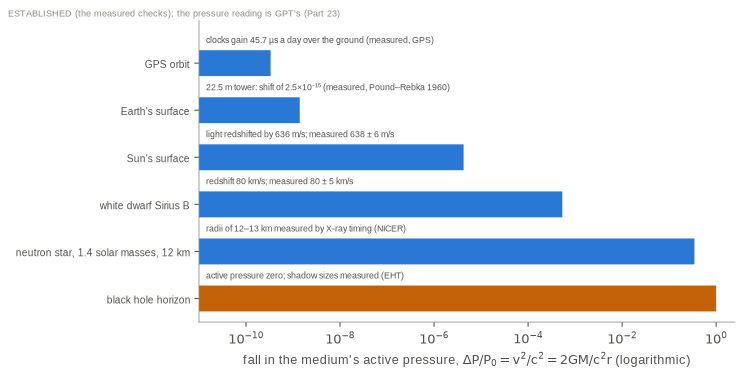
The checks:
GPS. The satellites’ clocks run fast relative to the ground by 45.7 microseconds a day because of their height, and slow by 7.2 because of their speed; the system corrects for both, and it would drift by kilometres a day without them.
Pound and Rebka, 1960: light sent up a 22.5-metre tower at Harvard arrived shifted by \(2.5\times10^{-15}\), within 10%, later 1%.7
The Sun: light from its surface is shifted by 638 \(\pm\) 6 metres a second, against 636 expected.8
Sirius B: the Hubble Space Telescope measured its light shifted by \(80.4\pm4.8\) kilometres a second, against 80.0 expected from its mass and radius.9
Neutron stars: X-ray timing from the International Space Station has measured their radii, 12 to 13 kilometres for about 1.4 solar masses.10
Horizons: the Event Horizon Telescope imaged the shadows of the black holes in M87 and at the centre of the Milky Way, at the sizes expected from their masses.1112
The relaxation boundary, from the same conversions: about 7,000 astronomical units for the Sun, and 8 to 11 kiloparsecs for the Milky Way, where its rotation curve flattens (Part 23).
Rhythms
Every structure has a rhythm set by its energy [Argued], \(f=E/h\) (Part 18).
the electron, \(1.24\times10^{20}\) hertz; the proton, \(2.27\times10^{23}\);
the caesium transition that defines the second, 9,192,631,770 hertz;
the hydrogen line, the most common radio signal in the universe, 1,420 megahertz;
the strontium optical clock, 429 terahertz, stable to about a part in \(10^{18}\).
The first edition’s “temporal resolution rate”, in s\(^{-1}\), is this rhythm.
Stiffness: The Second Pressure
The first edition defined a coherence resistance, \(C_{\text{res}}\), as how well a structure resists compression, “analogous to elastic modulus”. The measured quantity is the elastic modulus [Argued]: the bulk modulus, the pressure needed to compress a material by a given fraction. Diamond’s is 443 gigapascals, iron’s 170, lead’s 46, water’s 2.2. Its scale is set by the energy of the bonds: iron’s cohesive energy is \(5.8\times10^{10}\) joules per cubic metre. In GPT this is the second pressure, the energy of the medium organised into matter’s bonds, distinct from the medium’s free-space pressure [Hypothesis] (Part 20).13 The first edition’s \(C_{\text{res}}\), with its units of pressure per volume, is replaced by these measured moduli.
Spin and Orbit
The first edition defined a graviton torque on a spinning body, \begin{equation}T = -\gamma\,(\Omega - \Omega_{\text{corr}}), \label{eq:torque}\end{equation} driving its spin \(\Omega\) toward a preferred rate \(\Omega_{\text{corr}}\). This is the form of the tidal torque [Argued], with \(\Omega_{\text{corr}}\) the orbital rate and \(\gamma\) set by the friction inside the body as it is flexed by the tide. It drives a spin toward lock, and the Moon, which always shows the Earth the same face, has reached it. In GPT the tide is the difference in the medium’s inflow across the body, and the torque is delivered through the medium [Hypothesis] (Part 13).14
The first edition proposed that a body is locked when its spin and orbital angular momenta are equal, \(\kappa = I\omega/mvr \approx 1\). The numbers do not bear this out as written: \(\kappa\) is about \(2\times10^{-7}\) for the Earth and \(8\times10^{-6}\) for the locked Moon. What decides whether a body locks is the time it takes [Argued], which grows as the sixth power of its distance from what raises the tide and depends on its rigidity and internal friction.15 The measured pattern follows: the large moons close to their planets are locked, Pluto and Charon are locked to each other, and Mercury, close to the Sun, is held at three turns for every two orbits.
The Strong Field
The first edition’s Part 25 proposed a “deep field” equation with a nonlinear term, \(\nabla^2P_g + \alpha(\nabla P_g)^2 = -\rho_g\), for dense stars. No such term is needed for the motion of the medium: Part 23’s inflow, \(v^2=2GM/r\), holds at every strength [Argued], and in that form it reproduces the exact field of a non-rotating black hole (the Painlevé–Gullstrand form). What the strong field adds is two things.
What the medium is inside the horizon is owed [Open]: there the pressure formula goes below zero, and a self-repelling medium cannot have negative pressure. Something in the account changes there.
The limits are measured. [Argued] No white dwarf has been found above about 1.4 solar masses, the limit Chandrasekhar calculated in 1931;16 the heaviest neutron star measured is \(2.35\pm0.17\) solar masses.17 A fuller account of matter and medium under extreme compression is under consideration as its own paper.
What Remains to Be Derived
\(G\) from the medium: the relation between a mass and its intake. [Open]
An independent measurement of \(P_0\), and the factor \(\tfrac12\) in \(P_0=\tfrac12\rho_g c^2\). [Open]
The value of \(a_0\), from the rate at which the medium re-phases its ejecta (Part 15). [Open]
The size of the elementary charge, from the knot’s hand. [Open]
What the medium is inside a horizon. [Open]
The limits of white dwarfs and neutron stars from exclusion, in GPT’s terms. [Open]
Conclusion
GPT uses the SI throughout, and the SI itself is now defined by rhythm and by the speed of the medium’s waves: the second is a count of a caesium atom’s rhythm, the metre is set by \(c\), and the kilogram is measured as a frequency. The medium’s constants are partly measured, its electrical constants and its impedance of 376.73 ohms, and partly GPT’s own: a free-space pressure of about \(4.5\times10^{-10}\) pascals and a density of about \(10^{-26}\) kilograms per cubic metre. The conversions from GPT’s pressure to the quantities instruments read take a single form, and they are checked from a GPS satellite, where the pressure falls by three parts in ten billion, to the horizon of a black hole, where it falls to zero. The first edition’s derived quantities become measured ones: stiffness, the tidal torque and the time it takes to lock, and the rhythm of each structure.
Changes in the Second Edition
This list records what changed from the first edition and why. Changes to the argument alter what the paper claims or how it supports a claim; clarifications improve wording, sources or presentation and leave the argument as it was.
Changes to the argument
The first edition’s Part 24 is merged with the constants and conversions of its Part 25. The deep field receives a short section; a fuller treatment is under consideration.
The graviton pressure unit gp is identified as the pascal; SI units are used throughout. New: the SI’s 2019 definitions as rhythm and wave speed, and the kilogram as a frequency, with the Compton clock.
The area-based orbital force \(F = gp\cdot A = mv^2/r\) is withdrawn: bodies at the same radius orbit at the same speed whatever their shape or composition. Gravity acts on every particle (Part 14).
The light-speed formula \(v = c/(1+\beta\, gp)\) is withdrawn: it has light slowed where the pressure is higher, but light is slowed near masses, where the medium’s pressure is lower. Part 23’s index replaces it.
Shell stratification by \(\Delta gp\) is withdrawn as written: at any instant an orbit is possible at any radius; structure built over time is in Part 16.
New: a table of constants with how each is known, including the measured impedance of free space; a table of worked values from a GPS orbit to a black hole’s horizon, each with its measured check.
Coherence resistance is replaced by the measured bulk modulus and the energy density of bonds. The graviton torque is kept as the tidal torque. The lock criterion \(\kappa\approx1\) is replaced by the time to lock. The temporal resolution rate is the rhythm \(E/h\). The graviton impedance is identified with the medium’s impedance.
The resonance feedback coefficient \(R_{\text{field}}\), the coherence density, the graviton coupling coefficient \(\kappa_g\) and the constants \(\alpha\) and \(\gamma\) are withdrawn: none was defined by a measurement. The estimated value ranges are retired; \(P_0\) is about \(4.5\times10^{-10}\) pascals (Part 23).
The deep-field equation with its nonlinear term is withdrawn: the inflow holds at every strength. The resonance-lock wave \(P_0\cos(\ldots)e^{-\gamma t}\) is withdrawn: it makes the pressure negative half the time. New: the horizon as the surface where the active pressure reaches zero, and dense stars held by exclusion to measured limits.
Removed, as too far from the core: the calibration instruments (resonance-matched instruments, stratified field mapping, orbital corridor diagnostics), the resolvable pressure of \(10^{-8}\) pascals, the multiscale claims for biology and galactic corridor bifurcation, and the closing on propulsion and shielding.
Clarifications
The title changes from GPT Unit System and Dimensional Foundations (with the companion Constants, Conversions and Deep Field Formalism) to Units, Constants and Conversions, with the subtitle The Numbers of the Medium.
The cross-references to later parts are renumbered.
One figure, two tables, status marks and this list are added.