
Library › The Unified Framework for the Graviton Pressure Theory
Introduction
to the Unified Framework of the Graviton Pressure Theory — From Description to Mechanism
The Return of Causality: Purpose and Position of This Framework
Gravity has always been described. It has rarely been explained.
We can predict, to many decimal places, where a planet will be, how a falling body will accelerate, and how much light will bend as it passes the Sun. What we cannot say—in the dominant theories of physics—is what acts. What touches the falling apple? What is exchanged between the Earth and the Moon? What presses a person into a chair?
Graviton Pressure Theory (GPT) is an attempt to answer those questions: a physically grounded model of gravity that restores force, direction and structure to a domain long abstracted into geometry and silence. Where Newton described gravitational attraction without a mechanism, and Einstein replaced attraction with the curvature of spacetime without naming a carrier, GPT proposes a third path: gravity as the pressure of a physical medium acting on matter.
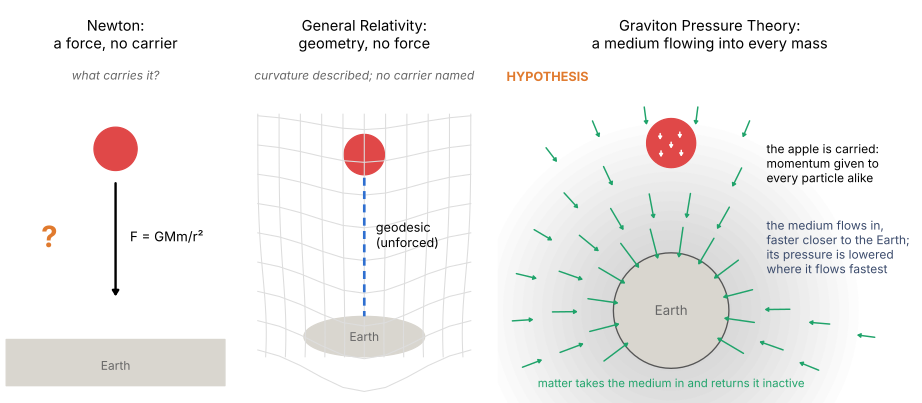
GPT does not seek to discard its predecessors. It seeks to complete them.
Newtonian force is retained—but given a carrier.
Einsteinian geometry is honoured—but as the mathematics of a physical flow, not a substitute for one.
Predictive accuracy must be preserved—but no longer at the cost of meaning.
Purpose: This framework exists to replace description presented as cause with mechanism that can be tested.
Scope: It addresses gravitational interaction across scales—from the weight we feel standing still, to tides, orbits, light and time, and into the structure of matter, magnetism and planetary motion.
Objective: To construct a model of gravity that is testable, visualisable, and rooted in a named physical interaction: what touches what, and what is exchanged.
Description and Mechanism
The central lesson of this framework—learned in writing it—is that physics has, over three centuries, come to accept description in place of mechanism, and then to forget that it made the exchange. Part 2 traces that history in detail.1 Here it is enough to state the distinction plainly, because everything that follows depends on it.
To describe a phenomenon is to state how it behaves: what follows what, by how much, under which conditions.
To give its mechanism is to name what acts: the physical interface between the things involved—what touches what, and what is exchanged.
Both are valuable. A description that predicts is a great achievement. The error is not description. The error is presenting a description as though it were the mechanism, and then treating the question of mechanism as answered, or as naive.
This framework applies one test throughout, to other theories and to its own claims alike:
The interface test. Does the explanation name the physical interface—what touches what, and what is exchanged—or does it only describe the action? Where it only describes, the gap is marked as a gap. A name is not a mechanism.
A complete theory of gravity must pass this test for everything gravity is observed to do—not only for orbits and light, but for weight, load, resistance and support, which are how gravity is encountered every moment of every day. Those obligations are set out, item by item, in the companion document The Gravity Constraint Set, and General Relativity is audited against them in The GR Silence Map.2 The audit does not claim that General Relativity is wrong. It records where it speaks, where it is silent, and what is customarily substituted where a mechanism would be.
Historical Arc: From Mystery to Structure
The demand for a mechanism of gravity is not new. It is as old as the law of gravity itself.3
Newton gave the law of universal gravitation and openly declined to give its cause. Privately he called action at a distance through empty space “so great an absurdity” that no competent thinker could accept it;4 publicly, he would frame no hypotheses.5
Pressure and push models followed almost at once. Nicolas Fatio de Duillier in 1690, and Georges-Louis Le Sage in the eighteenth century, proposed that gravity is the shadowing of a universal flux of tiny particles—bodies pushed together, not pulled.6 These models were abandoned in the nineteenth century, chiefly because a moving body should feel drag from such a flux, and because absorbing it should heat matter enormously. Maxwell set out the heating objection himself.7
Einstein reimagined gravity as the curvature of spacetime.8 The theory is extraordinarily accurate. It does not say what, physically, does the curving, or what acts on a body at rest to start it moving. Its own summary is relational: spacetime tells matter how to move; matter tells spacetime how to curve.9 Einstein himself told an audience in 1920 that in General Relativity space has physical qualities, and that in this sense “space without ether is unthinkable.”10
Modern cosmology preserves its descriptions by adding dark matter and dark energy, inferred from the gap between prediction and observation. In the standard model they make up about 95% of the universe’s energy content; ordinary matter is about 5%.11 After decades of searching, there is still no confirmed direct detection of a dark matter particle.
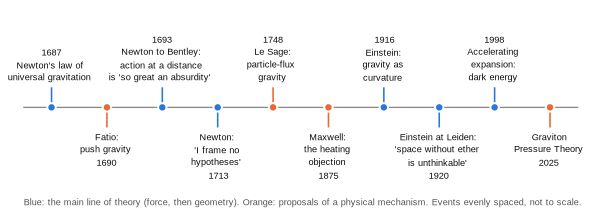
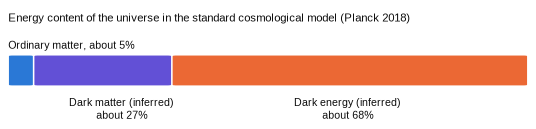
GPT stands in the lineage of the push models, and it must answer their objections, not ignore them. Where this framework believes it does, it says so; where the work is not yet done, it says that too.
What Graviton Pressure Theory Proposes
In outline—each part of the framework develops one layer in detail:
These proposals are developed in the parts that follow, and the current working model of the medium—its properties, and how they act together—is set out in The Mechanics of the Medium.13
The universe, on this view, does not bend. It presses.
Scientific Integrity and Transparent Method
GPT is not a theory hidden behind inaccessible mathematics. It is a framework built for scrutiny and replication. Every derivation, analogy and prediction is open to challenge. This framework keeps the historical lineage of ideas in view—acknowledging prior models, correcting their assumptions, and preserving the truths they contain.
GPT proceeds by the following commitments:
No invisible abstraction offered as a mechanism.
No field effect without a medium or structure that carries it.
No force without energy; no motion without transfer.
No stopping point disguised as an answer: where an explanation reaches a primitive, it is marked as the place where a deeper explanation has not yet been found—not as the place where none exists.
How claims are marked
So that readers can see at a glance what is claimed and on what footing, every claim this framework makes about GPT is marked by its status. Accepted fact, independent of GPT, carries no mark. A conclusion this framework argues in detail [Argued], which readers can check for themselves, has a solid underline. A proposal of GPT, not yet tested [Hypothesis], has a dashed underline. A question the framework has not yet answered [Open] has a dotted underline and a small circle. A passage that carries one status throughout has a bar of the same style in the margin. The key is repeated at the start of every part.
The text states each position as it now stands. Where a position has changed since the first edition, the change is recorded in a list at the end of the part, not in the running text.
Two registers
The physics papers of this framework make no claims about purpose or intent. They stand or fall on mechanism and measurement. The philosophical case—that the removal of cause and mechanism also removed mind, meaning and purpose from our picture of the universe—is made separately, in Part 2, in the register where it belongs. The two are related, but neither is allowed to borrow authority from the other.
This is not yet a confirmed theory. It is a scaffold of causal reinterpretation, rooted in what is observed and built to be tested.
Where the Work Stands
Honesty about the state of the work is part of the method.
General Relativity predicts gravitational phenomena with great accuracy and does not name a physical carrier of gravitational action.
Treating GR’s description as the complete mechanism of gravity is a category error, not a finding. [Argued] This is argued in detail in the papers on the Logical Closure and the Operational Constraints of the Equivalence Principle.14
GPT accounts qualitatively for the phenomena GR describes, and proposes explanations for the readings attributed to dark matter and dark energy without adding unseen matter. [Hypothesis]
What is calibrated. Like Newton’s constant \(G\), GPT’s strength of gravity is calibrated once, against measured gravity: the inflow of the medium toward a mass is matched to the observed acceleration \(g = GM/r^2\). That is the one calibration, stated as such. The slowing of clocks near a mass then follows from it. A clock is a structure of medium waves; near a mass the medium streams past it at the inflow speed, and a clock moving through the medium ticks slower, as each of its internal cycles has farther to travel, by the factor \(\sqrt{1-v^2/c^2}\). [Hypothesis] With \(v^2=2GM/r\), that is the measured gravitational redshift (Pound–Rebka, 1960; the Galileo satellites, 2018),15 with no second calibration.
What then follows without further fitting. If the medium affects the clocks and the rulers of matter in the same proportion—so that light’s speed, measured locally, is always \(c\)—then the bending of starlight and the radar delay past the Sun follow from that one calibration, with no adjustable constant [Argued]. Clocks supply half of the bending; rulers supply the other half. The result is GR’s 1.75 arcseconds and GR’s Shapiro delay, by a mechanical route (Appendix 1.A). Clocks and rulers change together because both are structures of the same medium: the medium that paces matter’s internal processes also sets the size of its structures. [Hypothesis]
Moving clocks and Mercury. The slowing of moving clocks is the same effect: every clock is slowed by its motion through the medium, whether the medium streams past it near a mass or it travels through the medium itself. [Hypothesis] The advance of Mercury’s perihelion depends on how rulers respond to the direction of the flow, which Part 8 takes up. [Open]
A constraint to meet. If light bending is refraction in a medium, it may depend on wavelength. Radio and optical measurements of the bending agree to within a few parts in a thousand,16 so any such dependence must be smaller than that. GPT expects no such dependence at leading order: the medium changes the electric and magnetic constants of space together, which leaves it matched for light of every wavelength, so radio and optical light bend alike, as measured. [Hypothesis]
The historic objections to push models—drag on moving bodies and the heating of matter—are addressed by specific proposals in this framework: that steady motion through the medium is not braked, and that the energy of the exchange is carried away by the returning, inactive medium rather than deposited as heat [Hypothesis]. A moving body takes in the medium faster at its leading face than at its trailing face, and that imbalance is its momentum: a path it carves through the medium. Held steady, the path costs nothing, so the body coasts. The resistance acts on the inside instead: more of the body’s exchange goes into carving the path, so its internal processes run slow, which is the slowing of moving clocks, and carving faster costs ever more energy as the speed nears \(c\) (Part 11). And matter is not heated, because the energy of the exchange passes through it and is returned to the medium (Part 6). [Hypothesis]
Distinctive predictions, where GPT and GR should differ measurably, are collected in Part 29, Experimental Divergence. Until such tests are carried out, GPT remains a hypothesis.
A framework that marks its own gaps invites others to close them. That is the intention.
Why This Framework Matters Now
A theory of gravity that relies on unseen matter and unexplained energy for most of the universe’s content may be describing the universe faithfully. Or it may be telling us where its description has run out. Either way, the question of mechanism deserves to be asked again—openly, rigorously, and without the charge of naivety that has kept it closed.
GPT asks it. And it restores three commitments that physics once took for granted:
That every motion has a cause.
That no force appears without energy.
That matter and field are not separate, but joined through pressure, exchange and coherence.
If GPT is right, it is more than another theory of gravity. It is a reunification of structure and mechanism. If it is wrong, the questions it asks will still need answers—and the standard it sets, that description must not pass for explanation, will still apply to whatever replaces it.
What Follows
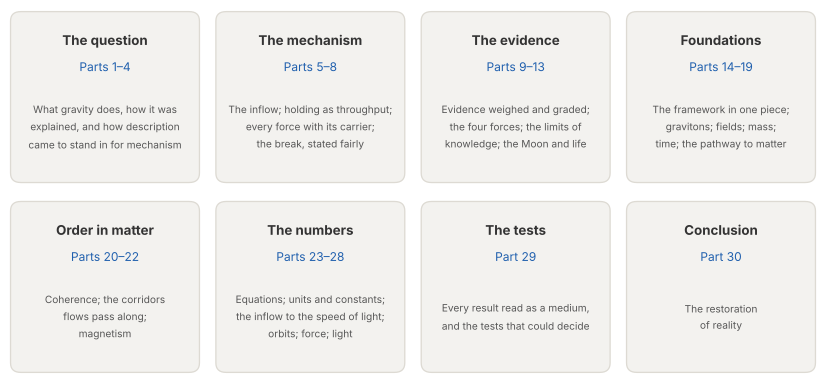
The thirty parts of this framework build the case in layers:
Foundations (Parts 2–4): how mechanism was set aside; an inventory of everything gravity actually does; and the path from Newton to GPT.
The core theory (Parts 5–8): gravity as pressure; work, force and stability rebuilt causally; the illusion of pull; and the points where GR and GPT cannot both be right.
Evidence and extensions (Parts 9–14): existing observations read through GPT; applied concepts; four famous classroom demonstrations re-examined (the sealed box, the feather and the ball, the comb and the water, and magnetism); the limits of materialist epistemology; the Moon and gravimetric modulation; and the transition into the detailed theory.
The medium in detail (Parts 15–22): gravitons; the properties of gravitational fields; mass; time; coherence; corridors and lattice resonance; and magnetism as gravimetric resonance.
Formalism and tests (Parts 23–29): the mathematical foundation; units, constants and conversions; planetary mechanics; natural force re-imagined; resonance transmission; and experimental divergence.
Conclusion (Part 30).
Where others wrote geometry, GPT proposes pressure.
Where others drew curves, GPT maps flows.
Where force became an abstraction, GPT seeks to make it real again—and to show its work.
This is gravity, offered for explanation.
Welcome to the pressure field.
Appendix 1.A: The Bending of Light: One Calibration, One Principle
This appendix shows how the bending of light and the radar delay past the Sun follow in GPT from one calibrated quantity and one stated principle, with no constant chosen to fit them. The structure is not new: Robert Dicke showed in 1957 that a medium which slows light and matter in this way reproduces the classical tests,17 and the idea has been developed since.18 What GPT adds is the physical medium that does the slowing.
Write the depth of the gravitational potential at distance \(r\) from a mass \(M\) as the small dimensionless number \[\Phi(r) = \frac{GM}{c^2 r}.\] At the Sun’s surface, \(\Phi \approx 2\times10^{-6}\).
1. Calibration and clocks.
The one calibration is the inflow, matched to Newton’s gravity: \(v^2 = 2GM/r\). A clock near the mass has the medium streaming past it at that speed, and a clock moving through the medium runs slow by \(\sqrt{1-v^2/c^2}\). So a clock at depth \(\Phi\) runs slow, compared with a clock far away, by \(\sqrt{1-2\Phi} \approx (1-\Phi)\). [Hypothesis] That is the measured gravitational redshift, and it follows from the inflow without a second calibration.
2. Principle: rulers.
The same medium that slows matter’s internal processes also sets the size of matter’s structures. GPT’s principle is that it changes both in the same proportion: a ruler at depth \(\Phi\) is shorter, as judged from far away, by the same factor \((1-\Phi)\). [Hypothesis]
3. Consequence: light is always measured at \(c\) locally.
An observer at depth \(\Phi\), using local clocks and rulers, measures light’s speed as \(c\)—as every local experiment finds. But measured from far away, where both the local ruler and the local second are rescaled, light near the mass travels at \[c_{\text{far}} = c\,(1-\Phi)(1-\Phi) \approx c\,(1-2\Phi),\] so the medium has an effective refractive index \[n(r) \approx 1 + 2\Phi(r) = 1 + \frac{2GM}{c^2 r}.\] The factor of 2 is not chosen. One half comes from clocks, the other from rulers.
In the variables of The Mechanics of the Medium, the same chain reads: the inflow lowers the medium’s active pressure to \(P/P_0 = 1 - 2\Phi\); clocks and rulers both scale as \(\sqrt{P/P_0} \approx 1 - \Phi\), with the free-space pressure \(P_0 = \tfrac12\rho_g c^2\), the value at which the pressure law and the clock law agree, since then \(P/P_0 = 1 - v^2/c^2\); and the index is \(n = P_0/P \approx 1 + 2\Phi\).19
4. The bending of light.
A ray passing a mass at closest distance \(b\) is bent toward the region of higher index. Summing the bending along the path gives \[\alpha = \frac{4GM}{c^2 b}.\] For a ray grazing the Sun (\(GM_\odot = 1.327\times10^{20}\,\mathrm{m^3/s^2}\), \(b = R_\odot = 6.957\times10^{8}\) m), \(\alpha = 8.49\times10^{-6}\) radians \(= 1.75\) arcseconds—the value measured in 1919 and since confirmed to high precision.
With clocks alone, and no change in rulers, the index would be \(1 + \Phi\) and the bending would be half as large: 0.875 arcseconds. That is the value Soldner obtained from Newtonian gravity in 1801, and Einstein from the equivalence principle in 1911. The full value requires both halves.
5. The radar delay.
A radar signal passing close to the Sun is delayed by the slower light near it. With the same index, the delay on a single pass is \[\Delta t = \frac{2GM}{c^3}\,\ln\!\frac{4 r_1 r_2}{b^2},\] where \(r_1\) and \(r_2\) are the distances of Earth and the far body from the Sun; a radar echo, which makes the trip twice, is delayed by twice this. This is the Shapiro delay, confirmed by the Cassini spacecraft to about two parts in \(10^{5}\).20
What this establishes, and what it does not.
From one calibration (the inflow) and one principle (clocks and rulers change together), GPT obtains the slowing of clocks, the bending of light and the Shapiro delay with no further fitting. [Argued]
These are the same first-order results as General Relativity. Agreement here shows that a medium can do what curvature does. It does not, by itself, show that the medium exists.
The clock rate follows from motion through the medium, and the principle that rulers change with clocks follows from both being structures of the medium. [Hypothesis]
Changes in the Second Edition
This list records what changed from the first edition (12 June 2025) and why. Changes to the argument alter what the paper claims or how it supports a claim; clarifications improve wording, sources or presentation and leave the argument as it was.
Changes to the argument
The claim that GPT “achieves the same observational match—and often greater precision” is withdrawn: it had not been demonstrated. GPT accounts for the phenomena qualitatively, and matching GR’s numbers by independent derivation is marked Open. Where GPT’s numbers agree with GR’s, the text now says which quantities are calibrated and which follow without fitting (Section 1.5 and Appendix 1.A).
“This is not a speculative idea” is replaced by “This is not yet a confirmed theory. It is a scaffold of causal reinterpretation… built to be tested.”
Gravitons as “real, massless directional carriers” are marked as a Hypothesis.
The scope no longer extends to quantum decoherence, which the framework does not treat; it now lists what the thirty parts cover.
The historic objections to push models (drag and heating) are now named, with this framework’s proposed answers, marked Hypothesis and Open.
“What Graviton Pressure Theory Proposes” now follows the working model of The Mechanics of the Medium: matter takes gravitons in and returns them inactive, the active pressure falls around a mass, and the higher pressure beyond presses inward.
New Appendix 1.A shows the bending of light and the Shapiro delay following from one calibration and one stated principle.
The closing line “This is gravitational structure, finally explained” is now “This is gravity, offered for explanation.”
Changes to the argument (November 2026, after Parts 6, 7 and 11)
The slowing of clocks near a mass is no longer a second calibration. It follows from the inflow: a clock is slowed by the medium streaming past it, by \(\sqrt{1-v^2/c^2}\), which with \(v^2=2GM/r\) is the measured redshift. Questions the first draft of this edition left open (moving clocks, dispersion, drag and heating, why clocks and rulers change together) are now answered in the text, marked as hypotheses. “The effect of the denser medium” on clocks is corrected to the medium streaming past them.
Clarifications
The opening now starts from the question of what acts. New sections: Description and Mechanism (with the interface test), How claims are marked, Two registers, and Where the Work Stands.
The historical arc is extended and sourced: Newton’s letter to Bentley and hypotheses non fingo; the push models of Fatio and Le Sage and why they were set aside; Einstein’s 1920 Leiden address; the Planck figures for dark matter and dark energy.
A fourth commitment is added: a primitive marks where a deeper explanation has not yet been found, not where none exists.
“Over 90% of the observed universe” is now “about 95% of the universe’s energy content” (Planck 2018). “The void” is now spacetime, since in GR spacetime is not a void.
Jammer’s Concepts of Force is cited to its first edition (1957). “It fulfils them” is now “It seeks to complete them”; “corridors” is now “flows”.
What Follows now maps all thirty parts in six groups, with Figure 1.4. Figures 1.1–1.3 are new.
Status labels in square brackets are replaced by marks drawn under the text (see the key at the start). The status of each claim is unchanged.