
Library › The Unified Framework for the Graviton Pressure Theory
Redefining Work
A Causal Reconstruction of Force, Stability, and Energy Under Graviton Pressure Theory
About This Paper
When something is held still against gravity, something is plainly going on. A robot arm draws current. A bridge strains. A magnet grips. Yet the textbook says that no work is done, and the lesson most students take away is that nothing is happening at all. Physics has never answered this observation well, and this paper takes it seriously.
It also shows what holding is not. Holding something still does not, in itself, consume energy. A stone arch has stood for two thousand years with nothing fed into it, and a permanent magnet holds its iron indefinitely. Where holding does cost energy, the cost belongs to the holder.
The answer depends on a starting point that runs through the whole framework: nothing is ever at rest. The book on the table, the bridge, the magnet and its iron are all moving through the graviton medium, and the medium is moving through them. Once that is the default, holding a weight is not an absence of activity. It is a steady exchange that passes through the load and its support without being used up.
Claims about Graviton Pressure Theory are marked by their status, as the key shows.
The Classical Definition and What It Leaves Out
Classical physics defines work as force times displacement:1 \[W = F\,d\cos\theta .\] If nothing moves, \(d=0\), and no work is done, however large the force and however long it acts. On the surface, this seems logically consistent.
It is also correct, in a precise and narrow sense. Work measures the energy delivered to the load. A weight held at a fixed height gains no height and no speed, so it gains no energy. Nothing in this paper disputes that.
The difficulty is what is said next. From “no energy is delivered to the load”, textbooks and classrooms slide to “holding requires no energy”, and from there to “nothing is happening”. The first statement is a measurement. The last is a conclusion the measurement does not support. A force that is maintained, hour after hour, is not nothing. The classical account calls this state static equilibrium, and stops. That is a description. It does not say what touches what, or what is exchanged, while the weight is held. [Argued]
This chapter asks that question.
The Holders Examined
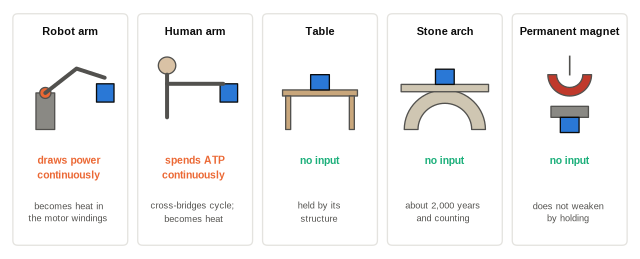
Five holders are examined here: a robot arm, a human arm, a bridge, a permanent magnet and an ordinary table. They hold weight in very different ways, and the comparison is what makes the answer visible. Figure 1 sets all five side by side.
The Robot Arm
A robot arm holding a 10 kg weight with its arm outstretched draws electrical power continuously.2 If the power is cut, the arm and the weight fall until something else takes the load. This energy is not a loss in the sense of waste: it is what keeps the weight where it is.
But follow it to where it goes. An electric motor makes torque by passing current through its windings, and the windings resist that current. The power drawn while holding still becomes heat in the copper. For a direct-current motor the torque is proportional to the current, and the heat to the square of the current, so the power needed to hold a load rises as the square of the torque.3 None of that energy reaches the weight. It is the cost of making force with a motor.
Put the same weight on a shelf, or engage a mechanical brake on the motor’s shaft, and the power drawn falls to zero while the weight stays exactly where it was.
The Human Arm
Hold the same weight out at arm’s length and you will tire within a minute. Muscle, like the motor, spends energy to hold still. The reason is mechanical: a muscle makes force by myosin heads repeatedly attaching to actin, pulling and releasing, each cycle consuming a molecule of ATP.4 The force is continuous only because the cycling is continuous. The fatigue you feel is real expenditure, and like the motor’s, it becomes heat. Your skeleton, holding your own body upright, does no such cycling and spends nothing.
The Bridge
A bridge carries its own weight and its traffic through cables in tension and beams in compression, continuously. It is tempting to read material fatigue as the sign of an ongoing energy input, as if a bridge would fail without one.
The evidence points elsewhere. Fatigue is driven mainly by changing loads: traffic, wind and the daily cycle of heating and cooling.5 A constant load does cause creep, a slow, real rearrangement within the material, but the energy for it comes from the load itself settling slightly lower, not from outside.6 Maintenance repairs damage; it does not hold the bridge up. The Roman aqueduct at the Pont du Gard has carried its own weight for nearly two thousand years. Its repairs have mended damage, but nothing has ever been fed into it to hold it up.7
Still, a loaded bridge is not inert. Its internal forces are maintained, its atoms are pressed together, and slowly, under creep, it changes. Something sustains that state. What it is, is the question of Section “What Maintains Structure”.
The Magnet
A permanent magnet holding an iron object against gravity draws no power, and it does not weaken by holding. Its strength fades only with heat, shocks or the passage of a great deal of time, whether it holds anything or not. Classical electromagnetism adds that magnetic forces on moving charges do no work at all.8
But here too a name stands where an interface should be. “Magnetic attraction” says that the force exists. It does not say what touches the iron, or what is exchanged across the gap while it is held. [Argued] In GPT, the magnet channels the medium into a circulation, and the iron is pressed along it (Part 11; Parts 21 and 22). [Hypothesis]
The Table
Finally, the most ordinary holder of all. A table holds a book for years at no cost. The textbook explanation of what is going on is the normal force: the atoms of the book’s cover and the table’s surface repel one another electromagnetically, and the table compresses very slightly until that repulsion matches the weight.9 That describes the balance. What the normal force measures, and what carries it, are taken up in Section “Holding as Throughput”.
This is the clearest case of all, and it shows the pattern. Motors and muscles pay continuously, because they make their force by a continuous process. Shelves, arches, magnets and tables pay nothing, because their force comes from their structure. The cost of holding belongs to the design of the holder, not to holding itself.
That settles the energy question for the holder. It does not settle what is happening in the load. For that, we have to drop an assumption the textbook makes before it starts.
The Load Is Never at Rest
Every one of these examples begins, in the textbook, with a load “at rest”. But no load is at rest. A book on a table is turning with the Earth at up to 465 metres per second, circling the Sun at 30 kilometres per second and travelling with the Sun around the galaxy at about 230 kilometres per second. Measured against the cosmic background radiation, which provides a physical frame of reference, it is moving at about 370 kilometres per second.10 It is never still, and it is never isolated.
We call the textbook’s starting point the Rest-and-Isolation Assumption: the practice of building the laws of force, inertia, charge and work from a body that is not moving and not interacting, two conditions that never occur, and then adding motion and surroundings back in as corrections. [Argued] The assumption is convenient, and the numbers it gives are often right. But it can hide the mechanism, and work is a clear case.
Work is not a property of a body alone. It depends on the frame from which the motion is measured, and the choice of frame is not innocent. Consider a suitcase on a train as it pulls out of a station. Seen from the train, the suitcase stays where it was put: nothing moves, and no work is done on it. Seen from the platform, the seat pushes the suitcase forward over hundreds of metres and does work on it, giving it a kinetic energy of \(\tfrac12 mv^2\). That energy is real, and it has a source. It did not come from the suitcase. It came from the train’s engine.11 The train’s frame hides the transport, and the payment that made it. (While the train accelerates, its frame is not an inertial one: the suitcase seems to stay put only because a frame force [FR] is booked against the seat’s push.) Once the train is cruising, nothing pushes the suitcase forward. It keeps its motion by itself, and the train’s fuel goes into the train’s own drag and rolling losses, a small share of which is the cost of carrying the suitcase.
So “no work is done” always means “no work is done in this frame”, and a frame can hide a transfer that is physically real. The textbook chooses the frame in which the load is still, and then treats the answer as if it were a fact about the load.
In Graviton Pressure Theory there is one frame that is physically special: the frame of the medium itself. And in that frame the held load is not still. Near the Earth, the medium flows inward toward the planet at the speed the framework calibrates to Newton’s gravity, \(v=\sqrt{2GM/r}\), which at the surface is about 11.2 kilometres per second. [Hypothesis]12 The book on the table is standing in that current. So is the bridge, and so is the weight in the robot’s hand.
Holding as Throughput
What does it mean to hold a load in a current?
Momentum flows through it. A steady force is a steady transfer of momentum: Newton’s second law in its original form says that force is the rate at which momentum is transferred. A 10 kg weight held still at the Earth’s surface is held by a force of 98 newtons, which means that 98 newton-seconds of momentum pass into it every second and out of it, into its support, every second, for as long as it is held. The support passes it on: through the table legs, the floor, the foundations and into the Earth. Physics has this description already. In the mechanics of materials, the stress inside a loaded body is exactly the density of this momentum current, flowing through the material.13 What the textbook treats as a frozen state is, in its own mathematics, a steady flow.
What carries it? Here the interface test applies. In the standard account, the momentum is passed from atom to atom by electromagnetic forces, and at the last step that is a name, not a contact: what touches what, between two atoms that never meet, is not said. Even classical electromagnetism, when it is pressed, places the momentum in the field between the charges.14 In GPT, the carrier is the medium. The medium streams through the load, the load’s matter takes up part of that flow, and the support holds the load against it. Weight is the force that holds a body against the medium’s flow; the support’s push is the reaction to it. [Hypothesis]
The compression makes it visible. The normal force is a reaction. It mirrors what it receives, and it exists only while something is pressing. Place a foam pad between the book and the table. The pad compresses, and it stays compressed for as long as the book is there; lift the book, and the pad springs back at once. The compression is not the record of a push that happened once. It is the continuing response to a push that is still being applied, at every moment the book rests on it. The table does the same, by an amount too small to see. And the compression shows which way the action runs: the pad is pressed from above. Something presses the book down, and the table’s push up is the reply. In the language of the previous paragraphs, the compression is the momentum current made visible: the stress is the flow, and the strain is the material’s response to it.
The normal force is the signature. The normal force is not a separate thing that happens to balance the weight. It equals the rate at which momentum is delivered to the support: 98 newtons for a 10 kg load, which is 98 newton-seconds every second. A bathroom scale reads exactly this, so every scale reading is a measurement of the momentum current. In GPT, that current is delivered by the medium’s inflow, so every scale reading measures the medium’s delivery. [Hypothesis]
What stops the book passing into the table? The standard account rests finally on the Pauli exclusion principle, which forbids two electrons from occupying the same state.15 That is a rule, not a carrier: it says that matter does not interpenetrate, not what touches what at the boundary. GPT proposes a carrier. Matter takes in the medium and ejects it again. Where the outflows of two bodies meet densely, at their contact, the ejected medium is re-activated into its self-repelling state, and its pressure first resists compression, then creates and holds the boundary between the two bodies. This is where the delivered momentum goes: it is returned as solidity. [Hypothesis] The two accounts need not be rivals. If electromagnetism is itself a property of the medium, as The Mechanics of the Medium proposes, “electromagnetic repulsion” may be this pressure described in electromagnetic language. [Hypothesis] Physics already knows a pressure set by boundaries: in the Casimir effect, two close, uncharged plates are pressed together.16 The standard account describes it by the modes the boundaries allow, and names no carrier. The re-activation switches on only at atomic distances because each atom’s organised medium reaches only a short way beyond it, dying away over a few hundredths of a nanometre; the outflows are re-activated only where those short tails overlap, so the push rises steeply at the size of an atom and is absent before contact. And the boundary pressure matches the delivered momentum the way the foam pad does: the bodies settle together until it does. [Hypothesis]
Standard elasticity describes the same compression as a static equilibrium that needs no continuing energy, and here the two accounts agree on the numbers. Compressing the pad takes a fixed amount of energy once, supplied by the book settling a few millimetres, and after that the energy stored in the pad stays the same. What continues is not energy deposited in the pad, but the force itself: the momentum passing through it. The pad does not prove the throughput, because standard physics predicts the compression too. What it shows is that the force is continuous, which is exactly what the throughput explains and what the textbook’s “nothing is happening” denies. [Argued]
Energy flows through it too, relative to the medium. The rate at which a force transfers energy is the force times the speed. In the laboratory frame the speed is zero, so the energy rate is zero: the textbook answer. In the frame of the medium, the load is moving at the inflow speed [Hypothesis], and the rate is \[F\,v \approx 98\ \text{N} \times 11\,200\ \text{m/s} \approx 1.1\ \text{MW}\]for a 10 kg weight. This is large, and it does nothing to the load or the table. It does not heat them, because it is not deposited in them: it passes through the load and its support. Nor can it be deposited in the Earth. For the Earth’s own mass, energy deposited at this rate would exceed the heat that flows out of the Earth, about 47 terawatts,17 by many orders of magnitude. It is returned to the medium: carried away from the mass by the ejected medium, which is recharged far out, at the relaxation boundary. [Hypothesis]18 Throughput is not consumption.
A water wheel locked in place in a river is a fair picture. The river presses on it continuously, and the wheel’s mounting must hold firm against that pressure. The river’s energy flows past and around the wheel the whole time. None of it is used up by the wheel, and the wheel does not warm. Yet anyone who says that “nothing is happening” to a locked wheel in a river has not looked at the river.
Figure 2 draws the book on the table in this way.
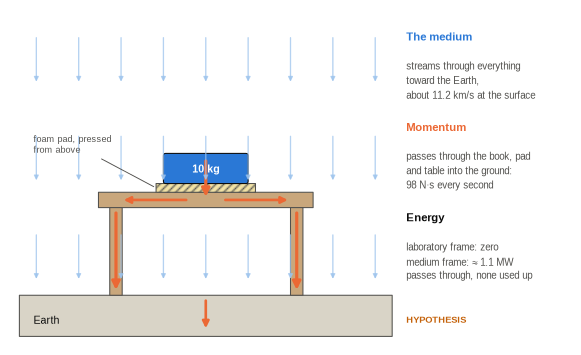
Holding is an active, continuous interaction. The textbook’s “zero work” is not wrong, but it is incomplete: it reports one ledger and leaves the other unopened.
What Maintains Structure
One question remains, and it is the deepest. A table holds a book for years with no battery. Its atoms keep their places and their spacing under load. What keeps them there?
The standard answer is the electromagnetic bond, described with great precision by quantum mechanics. It accounts for the strength and stiffness of materials. It does not say what a bond is made of in the sense the interface test asks for: what touches what, and what is exchanged, for as long as the bond holds.
GPT’s answer follows from its account of matter. In The Mechanics of the Medium, matter is a structure of the medium: organised, self-sustaining patterns of the medium’s own motion. [Hypothesis]19 A pattern in a flowing medium persists only because the medium keeps renewing it, as a standing wave in a stream persists only because the water keeps arriving. On this view, every structure, the table, the bridge and the book, is maintained continuously by the medium that flows through it. Stability is active, and what pays for it is not the table, and not a battery: it is the medium. [Hypothesis]
A material’s stiffness follows from how short and steep its atoms’ tails are: the more tightly bound the atoms, the stiffer the contact. Diamond is about sixty times stiffer than lead. [Hypothesis] Much of the wider range, from steel to rubber, comes from structure rather than from the contacts: rubber is soft because its long chain molecules uncoil.
Work Redefined: Two Ledgers
The classical definition of work does not need to be replaced. It needs a second ledger beside it. Keep the classical definition, and open the ledger it leaves closed.
Ledger one: energy delivered. The classical work, \(W=\int F\,dx\), measured in the frame in which the load is still, counts the energy that changes the load’s position or speed. For a held load it is zero, and it is correct.
Ledger two: what passes through. For a load held by a force \(F\) for a time \(t\):
the momentum throughput is \(J = F\,t\). For a 10 kg weight held for one hour, \(J = 98\ \text{N}\times3600\ \text{s} \approx 3.5\times10^{5}\) newton-seconds, carried from the load through its support into the ground;
the energy throughput, measured in the frame of the medium, is \(F\,v_{\text{medium}}\), about 1.1 MW at the Earth’s surface for 10 kg. It passes through and is not used up. [Hypothesis]
Neither ledger is the cost of the holder. That is a third account, belonging to the holder’s design: the motor’s heat, the muscle’s ATP, and for the table, the arch and the magnet, nothing.
With the two ledgers side by side, the paradox of holding dissolves. The textbook is right that no energy is delivered to the load. The observation that holding is an active and continuous interaction is right too. They are statements about different ledgers.
What Would Test This
What has been measured, and what remains to be tested, is this.
The holder’s cost. The power a motor needs to hold a load rises as the square of the torque, not in proportion to it, because the loss is resistive heating. This is standard motor physics, easily measured, and it confirms that the cost belongs to the holder.
No heating from passive holding. A table, an arch or a magnet holding a load shows no heating attributable to the load. Throughput, unlike consumption, predicts exactly this. It is a consistency check, not a test that separates GPT from the standard account.
Creep. The energy released as a loaded structure slowly creeps equals the weight times the distance it settles. This, too, is standard, and GPT agrees with it.
A test bed: the compressed pad. If the throughput has any part that is not perfectly conservative, a compressible layer under a sustained load is the place to look for it: as heating, or as creep, beyond what the standard account predicts. Foams creep under load by themselves, so that standard creep must be measured and subtracted first. GPT, which holds that the throughput is returned to the medium in full, predicts no excess [Hypothesis], and a measured excess would count against the reading as stated.
Free fall. A falling body moves with the medium, so no momentum needs to be relayed through it, and nothing in it should be compressed. That is what astronauts in orbit experience. It is a consistency check, passed.
The signature of throughput. The momentum throughput already has a measured signature: the normal force. Every scale reading measures the rate at which momentum is delivered (Section “Holding as Throughput”). For clocks, the same picture of the medium streaming through matter predicts their slowing near a mass, and that has been measured.20 The energy throughput itself leaves no separate local mark, because it passes through and is returned; its signature is the streaming of the medium that carries it, which the slowing of clocks measures. [Hypothesis]
Conclusion
The classical definition of work is not wrong. It answers one question—how much energy reaches the load—and answers it correctly. Its failure is in what it is used to imply: that a held weight, a standing bridge or a gripping magnet is a scene in which nothing happens.
Graviton Pressure Theory begins from the other end. Nothing is at rest. The medium streams through every body near a mass, and holding a body still is holding it against that flow. A steady current of momentum passes through the load and its support into the ground, and every scale reading measures it. Relative to the medium, a steady current of energy passes through as well, and is returned to the medium. Neither is used up. Motors and muscles pay to hold because of how they make force; tables and arches pay nothing because their structure, maintained by the medium, does the holding.
Stability is not passive. It is a continuous exchange with the medium. The exchange flows through, and the medium pays for it.
Changes in the Second Edition
This list records what changed from the first edition (12 June 2025) and why. Changes to the argument alter what the paper claims or how it supports a claim; clarifications improve wording, sources or presentation and leave the argument as it was.
Changes to the argument
“Holding consumes energy” and “stability inherently demands constant energy input” are withdrawn. Tables, arches and permanent magnets hold indefinitely with no input. They are replaced by throughput: momentum, and relative to the medium energy, passes through the load and its support and is not used up (Section 6.4). The first edition’s observation, that holding is an active and continuous interaction, is kept.
The robot arm. Its power draw becomes heat in the motor’s windings, and a brake or a shelf holds the same load at zero power, so the cost belongs to the motor, not to holding. The first edition’s claim that the energy needed scales in proportion to the load is corrected: holding power rises as the square of the torque.
The bridge. The first edition argued that material fatigue shows an ongoing energy input. Fatigue comes mainly from changing loads; creep under a constant load is real, but its energy comes from the load settling; maintenance repairs damage rather than holding the bridge up. The Pont du Gard is the counterexample. The point that a loaded bridge is not inert is kept.
The magnet. The claim that a magnet’s grip consumes energy is withdrawn. “Magnetic attraction” is marked as a name without an interface, taken up in Part 22, where the medium’s pressure across the field is the interface.
The definition of work. The first edition proposed \(W_{\text{GPT}}=\int (F\cdot d_{\text{coherence}})\,dt\). As written, it mixes units (force times distance times time is not energy) and does not say what \(d_{\text{coherence}}\) is. It is replaced by the two ledgers of Section 6.6, with the classical definition kept.
The five “experimental confirmations” (robotic systems, structures, magnets, aircraft and quantum systems) cited no experiments and are withdrawn. Section 6.7 states what has been measured and says that a test of throughput is still owed.
The normal force is now read as the signature of the momentum current: it equals the rate at which momentum is delivered, so every scale reading measures it. GPT’s proposed carrier of solidity, the re-activated outflow at the boundary between bodies, is set beside the standard account, which rests on the Pauli exclusion principle, a rule rather than a carrier (Section 6.4).
The energy throughput is returned to the medium, not deposited in the Earth, whose measured heat flow rules that out; the route of return is open (Section 6.4).
New: The Load Is Never at Rest (Section 6.3), which names the Rest-and-Isolation Assumption and shows that work depends on the frame; Holding as Throughput (6.4); and What Maintains Structure (6.5).
Further changes (8 November 2026, after Part 11)
Questions this edition first left open are now answered in the text, marked as hypotheses: why the contact push switches on at atomic distances (the short tails of each atom’s organised medium), why the boundary pressure matches the delivered momentum, how the energy throughput is returned, what sets stiffness, and why the energy throughput leaves no separate local mark. The compressed-pad test now states GPT’s prediction: no excess.
Clarifications
The three examples of the first edition are joined by a human arm and a table, so that the comparison shows the pattern: the cost of holding belongs to the design of the holder.
The image of a water wheel locked in a river. Figures 6.1 and 6.2 are new.
Citations corrected: Griffiths is cited to §5.1.2, “Magnetic forces do no work”, in place of §5.2; the robotics handbook is cited without a chapter, which could not be verified; the decoherence citation is removed with the quantum example it supported. New sources on motors, muscle, fatigue, the Pont du Gard, the cosmic background dipole, momentum flux and field momentum.
Status labels in square brackets are replaced by marks drawn under the text (see the key at the start). The status of each claim is unchanged.